A 3D sign board is a sign whose letters, logo or graphic stand out from the wall or panel behind it instead of sitting flat. The types are usually described in three ways: by material (acrylic, stainless steel, aluminium), by lighting (front-lit, back-lit, halo-lit or non-illuminated) and by construction style (cut-out letters, logos or channel letters). These are different ways of describing a sign, not separate products, so a single sign can fall into several categories at once.
This guide explains what each type is, where it is commonly used, and what to think about when choosing between them. Businesses can pick different materials, construction methods, and lighting options depending on where the sign will be installed and how it needs to look.
What Are the Different Types of 3D Sign Boards?
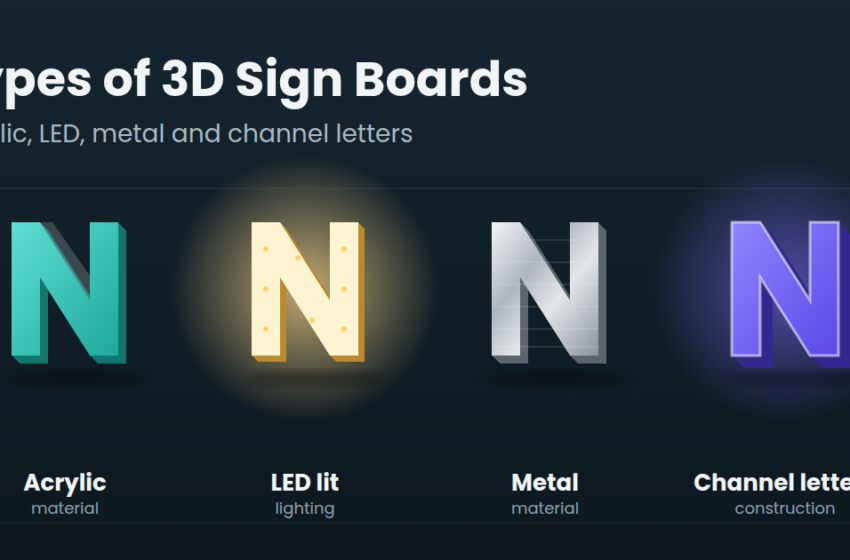
The four types people search for most often are:
- Acrylic 3D sign boards: dimensional letters or logos made from acrylic sheet.
- LED 3D sign boards: dimensional signs that use LED lighting to illuminate the letters or the wall behind them.
- Metal 3D sign boards: letters and logos made from metals such as stainless steel or aluminium.
- Channel letters: individually fabricated letters built as hollow, dimensional units, often with internal lighting.
These categories overlap. An acrylic 3D sign can include LED illumination. Channel letters commonly combine acrylic faces with metal sides. A metal logo can be back-lit. When you compare types, keep in mind that “acrylic” and “metal” describe the material, “LED” describes the lighting, and “channel letters” describes how the sign is built.
Acrylic 3D Sign Boards
What Are Acrylic 3D Sign Boards?
Acrylic is a rigid, lightweight plastic sheet that can be cut, shaped and finished in many ways. In signage, it is usually cut into letters or logo shapes and mounted so they stand away from the wall or sit on a backing panel. Acrylic is popular for indoor and reception signage because it is easy to shape and available in a wide range of colours.
Common Uses of Acrylic 3D Signs
- Retail stores and boutiques
- Offices and reception walls
- Showrooms
- Restaurants and cafes
- Clinics and professional practices
Acrylic 3D Sign Finishes and Design Options
Acrylic offers plenty of design flexibility:
- Colours: solid, translucent, mirrored or frosted sheets, or painted surfaces.
- Thickness: thicker sheet gives the letters more depth and a bolder edge. Layering two or more sheets can add extra dimension.
- Lettering and logos: simple lettering is straightforward, while detailed logos need more careful cutting and finishing.
- Surface finishes: glossy, matte or brushed-look finishes change how the sign catches light.
- Illumination: acrylic can be left unlit or combined with LEDs, either shining through translucent faces or lighting the wall behind.
What to Consider When Choosing Acrylic
Start with where the sign will live. Acrylic suits many indoor settings well. For outdoor use, ask about the specific grade of acrylic, how it handles sunlight and heat, and how it will be fixed. If the sign will be lit, decide early whether the acrylic should glow or simply reflect the room’s lighting, because that changes the sheet type and construction.
LED 3D Sign Boards
LED is mainly a lighting method, not a base material. An “LED 3D sign” is typically a dimensional sign made from acrylic, metal or both, with LED modules added to light it.
What Are LED 3D Sign Boards?
They are 3D signs where LEDs (light-emitting diodes) provide illumination. LEDs are compact, so they can be placed inside letters or behind them, and they can be arranged to give an even glow. The result is a sign that stays visible after dark.
Front-Lit 3D Signs
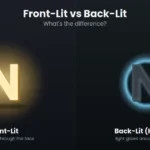
In a front-lit sign, the light shines forward through the face of the letter. The face is usually translucent acrylic, so the whole letter glows. This is the classic look for shopfront lettering and is easy to read at a distance.
Back-Lit and Halo-Lit 3D Signs
In back-lit (also called halo-lit or reverse-lit) signs, the LEDs sit behind the letter and shine toward the wall. The letter itself stays solid and dark against a soft glow around its edges. This gives a more subtle, dimensional effect and is often paired with metal letters. It works best when the mounting surface is suitable for reflecting light.
Where Illuminated 3D Signs Are Commonly Used
- Shopfronts and retail stores
- Restaurants and hotels
- Corporate buildings and commercial spaces
- Reception areas with feature walls
What to Consider Before Choosing LED Illumination
| Factor | Why it matters |
| Visibility | The brightness should suit the surroundings and not overwhelm the design |
| Viewing distance | Larger letters and stronger lighting help for sign viewed from far away |
| Day and night use | Some designs read well in daylight, others mainly at night |
| Sign design | Thin letters and complex logos may limit lighting options |
| Power supply | Wiring and power units need to be planned into the installation |
| Maintenance access | LED modules and power supplies should be reachable for future service |
Metal 3D Sign Boards
Metal dimensional signage is chosen when a sign needs a solid, durable appearance. The two metals most often used are stainless steel and aluminium.
Stainless Steel 3D Signs
Stainless steel resists corrosion and can be finished in several ways, such as brushed, polished or mirror-like surfaces. Coloured finishes are also possible. It is commonly used for corporate lobbies, reception areas and brand signage where a refined, weighty look is wanted.
Aluminium 3D Signs
Aluminium is lighter than stainless steel, which can make mounting easier, especially for larger letters. It can be painted or coated in many colours, and it is widely used for lettering and logos on commercial buildings.
Where Metal 3D Signs Are Commonly Used
- Corporate offices and reception walls
- Hotels and hospitality entrances
- Retail stores and shopping centre frontages
- Building facades
What to Consider When Choosing Metal Signage
- Weight and fixing method: heavier letters need suitable mounting and a wall that can support them.
- Finish: brushed, polished and coated finishes look and age differently.
- Location: for outdoor use, ask about coatings and how the material handles weather.
- Lighting: metal letters can be unlit, halo-lit or combined with lit faces.
Channel Letters
Channel letters are a distinct construction style, so they get their own section.
What Are Channel Letters?
Channel letters are individually fabricated letters or shapes built like small open boxes. Each has a face on the front and sides (often called returns) that give the letter depth. Because each letter is built as its own unit, the sign can follow the exact font or logo shape.
Illuminated Channel Letters
Many channel letters contain LED modules inside, with a translucent face that lets the light through. Variations include:
- Front-lit: light passes through the face.
- Back-lit or halo-lit: the face is solid and light shines out the back.
- Combined: some designs light both the face and the surrounding wall.
Channel letters can also be made without lighting.
Where Channel Letters Are Used
- Retail stores
- Restaurants
- Shopfronts
- Commercial buildings
- Hotels
Channel Letters vs Other 3D Lettering
Channel letters are built hollow and often illuminated from within, while solid cut-out letters (such as acrylic or metal) are typically cut from a single piece of material. Channel letters can achieve greater depth and internal lighting, while cut-out letters are often simpler in construction.
3D Sign Board Materials and Construction Methods
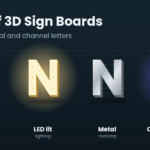
One way to make sense of the terminology is to separate three ideas:
| Category | Options |
| Material | Acrylic, aluminium, stainless steel |
| Lighting | Front-lit, back-lit, halo-lit, non-illuminated |
| Construction style | Cut-out 3D letters, logos, channel letters |
Any sign is a combination of one choice from each category. For example, a sign might use aluminium channel letters with acrylic faces and front-lit LED illumination. Another might be stainless steel cut-out letters with halo lighting. Thinking in these three layers makes it easier to describe what you want and to compare options.
How Do You Choose Between Different 3D Sign Board Types?
There is no single best type. The right choice depends on the situation.
Consider Where the Sign Will Be Installed
Indoor and outdoor locations have different requirements. Outdoor signs face sunlight, heat, dust and moisture, so materials, coatings and electrical components need to be suitable for exposure. External signs may also need approval from local authorities, so check the requirements for your location.
Consider How the Sign Will Be Viewed
Think about the viewing distance and angle. A sign read from a busy road needs larger, clearer lettering than one seen at close range in a reception area.
Decide Whether Illumination Is Needed
If the sign must be visible after dark, lighting is important. Indoor feature walls may not need it. Choose front-lit for maximum legibility, or halo-lit for a subtler glow.
Choose a Suitable Material and Finish
Match the material to the environment and the look. Acrylic offers colour flexibility, stainless steel offers a solid appearance, and aluminium offers lighter weight with many coating options.
Consider the Brand’s Visual Style
The sign should match your logo, colours and interior or facade design. A minimal brand may suit brushed metal, while a colourful one may suit acrylic or lit faces.
Consider Installation and Maintenance Requirements
Ask how the sign will be mounted, how it will be powered and how it can be serviced. Planning access for LED maintenance early avoids problems later. If you’re planning custom 3D sign boards, these details are usually part of the design brief.
Consider Your Budget
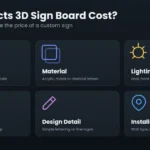
Cost depends on a combination of material, size, construction complexity, lighting and installation conditions. Because these factors vary widely, the most reliable way to understand cost is to share your requirements and get a quote based on the actual specification.
3D Sign Board Types Compared
| Type | Main Material/Construction | Lighting | Common Applications |
| Acrylic 3D signs | Acrylic dimensional letters or logos | Optional | Offices, retail, reception |
| LED 3D signs | Dimensional sign with LED illumination | Yes | Shopfronts, retail, commercial spaces |
| Metal 3D signs | Stainless steel or aluminium | Optional | Corporate, hotels, retail |
| Channel letters | Individually fabricated dimensional letters | Often LED | Shopfronts, retail, restaurants |
These categories are not mutually exclusive. A sign can combine acrylic, metal, LED lighting and channel-letter construction.
Where Are Different Types of 3D Signs Used?
Retail Stores and Shopfronts
Shopfronts often use illuminated channel letters or LED-lit signs so the brand stays visible in the evening. Inside stores, acrylic or metal logos work well on feature walls.
Restaurants and Cafes
Restaurants tend to use lit signage outside and decorative acrylic or metal lettering inside, where the mood and colour of the sign help set the atmosphere.
Offices and Reception Areas
Reception walls commonly use stainless steel, aluminium or acrylic logos. Lighting is often subtle, such as halo lighting, to keep the look clean.
Hotels and Hospitality Spaces
Hotels use dimensional signs at entrances, lobbies and wayfinding points. Metal finishes and halo lighting are common choices.
Clinics and Professional Businesses
Clinics and professional practices usually need clear, understated signage. Acrylic or metal letters in a simple layout are typical.
Showrooms and Commercial Interiors
Showrooms often use larger, more expressive dimensional signs, combining materials and lighting to highlight the brand.
How 3D Sign Boards Are Designed and Made
Most 3D sign projects follow a similar process. (A dedicated article, “How 3D Sign Boards Are Made: From Design to Installation,” can be linked here once published.)
Requirement and Measurement
The process begins with understanding where the sign will go, its size, the surface it will be mounted on and the viewing conditions. Accurate measurements of the installation area are taken.
Sign Design
The logo or lettering is prepared as a design, showing dimensions, depth, colours and lighting. This is usually reviewed and approved before production.
Material Selection
The material, finish and thickness are chosen based on the design and the environment.
Fabrication
Letters or logos are cut and assembled. Channel letters are built as individual units with faces and returns.
Lighting Integration
For illuminated signs, LED modules, wiring and power units are fitted and tested.
Finishing and Quality Checks
Surfaces are finished, and the sign is checked for alignment, colour and lighting performance.
Installation
The sign is mounted on site using fixings suited to the wall and weight, and connected to power if illuminated.
Frequently Asked Questions About 3D Sign Board Types
What are the main types of 3D sign boards?
The main types are acrylic 3D signs, LED (illuminated) 3D signs, metal 3D signs in stainless steel or aluminium, and channel letters. These categories often overlap.
What is the difference between acrylic and metal 3D signs?
Acrylic is a lightweight plastic available in many colours and finishes. Metal signs, such as stainless steel or aluminium, have a more solid appearance and are often chosen for corporate or high-durability uses. Both can be lit or unlit.
Are all 3D sign boards illuminated?
No. Many 3D signs have no lighting at all. Illumination is an option that can be added to acrylic, metal or channel-letter signs.
What are channel letters?
Channel letters are individually fabricated dimensional letters with a face and sides, giving them depth. They are often lit with internal LEDs but can also be unlit.
Can acrylic 3D signs have LED lighting?
Yes. Acrylic 3D signs can be lit from within or from behind, depending on the design and the type of acrylic used.
What is the difference between front-lit and back-lit 3D signs?
Front-lit signs shine light through the face of the letter, so the letter itself glows. Back-lit (halo-lit) signs shine light behind the letter, creating a glow around its edges on the wall.
Which materials are commonly used for 3D signs?
Acrylic, aluminium and stainless steel are the most common. Other materials are also used depending on the design.
Can a 3D sign include a business logo?
Yes. Logos can be cut, fabricated or built as dimensional elements in acrylic, metal or as channel-style shapes. Very detailed logos may need simplification for best results.
Explore Custom 3D Sign Board Solutions
The right 3D sign depends on your branding, installation location, desired finish, lighting requirements, and available space. If you’re planning a custom dimensional sign, explore Noor Al Advertising’s 3D sign board solutions for design, fabrication and installation.