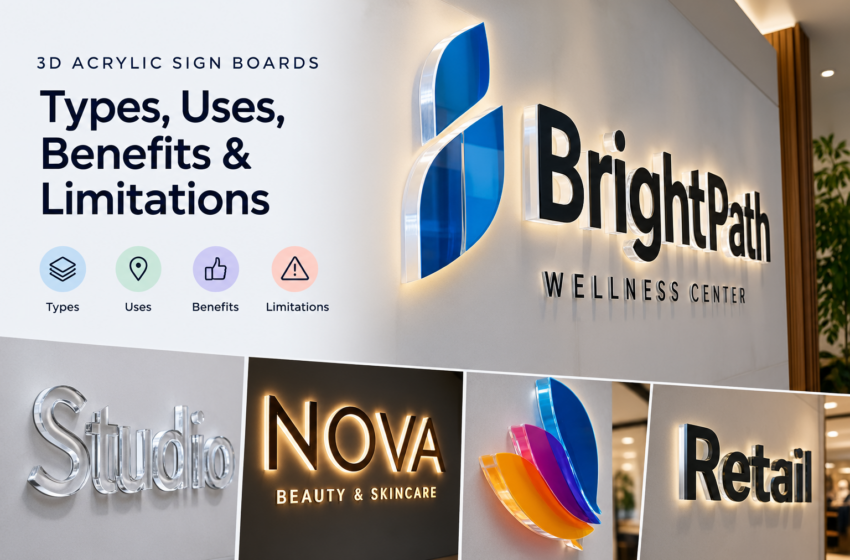
Quick answer: 3D acrylic sign boards are signs with letters or logos cut or built from acrylic sheet so they stand out from the wall. They vary by sheet type (cast or extruded), construction (flat-cut, layered or built-up), finish, lighting and mounting. Acrylic suits offices, retail and hospitality interiors well. For outdoor use, the acrylic grade, fixing method and climate matter.
Acrylic is one of the most common materials for dimensional signs. It can be cut into almost any letter or logo shape, it comes in a wide range of colours and finishes, and it is much lighter than most metals. That is why 3D acrylic signboards are so popular for reception walls, shops, restaurants and clinics.
Acrylic is not right for every sign, though. It scratches more easily than metal, it reacts to heat, and its performance outdoors depends heavily on the grade used and how the sign is fixed. This guide covers the main types of 3D acrylic signs, where they work best, their benefits and limitations, and how to decide whether acrylic suits your project.
What Are 3D Acrylic Sign Boards?
A 3D acrylic sign board is a sign where letters, logos or shapes made from acrylic stand out from the wall or backing panel, giving the sign visible depth.
Acrylic, chemically known as polymethyl methacrylate (PMMA), is a rigid, transparent plastic sold in sheets. Signmakers use it because it can be cut with lasers or CNC routers, polished at the edges, bonded, heated and shaped, and produced in many colours.
A flat acrylic sign is a single panel with a printed or engraved surface. A 3D acrylic sign has physical depth, which comes from one of three things: thick material, stacked layers, or letters built as hollow units. Mounting adds to the effect. Stand-off fixings hold the letters slightly away from the wall, leaving a shadow gap behind them.
Acrylic is one of several materials used for dimensional signage, alongside aluminium, stainless steel and channel-letter construction. For a wider comparison, see this guide to the types of 3D sign boards.
What Types of Acrylic 3D Signs Are Available?
Acrylic signs vary in five ways: sheet type, construction, finish, lighting and mounting. A single sign combines one choice from each.
Cast vs Extruded Acrylic
The two main sheet types are made differently. Cast acrylic is produced by pouring liquid material into a mould and letting it cure. Extruded acrylic is pushed through a die in a continuous process.
In general, cast sheet is often chosen for thicker signs, deeper colours and work that involves routing or polishing. Extruded sheet tends to have more uniform thickness and is often more economical. Both are widely used in signage, and the better choice depends on the design and the fabricator’s process. It is reasonable to ask which type a supplier uses and why.
Flat-Cut, Layered and Built-Up Construction
- Flat-cut: letters or logos cut from a single sheet and mounted on the wall. This is the simplest construction and gives a clean outline.
- Layered: several pieces of acrylic bonded together, sometimes in different colours or sizes, to create stepped depth.
- Built-up (fabricated): a face and side walls (called returns) joined to form a hollow letter. This gives greater depth and allows lighting inside. It is closely related to channel-letter construction.
Finishes
Common finishes include:
- Gloss: bright and reflective, but fingerprints and scratches show more easily.
- Matte or frosted: softer, and better at hiding minor marks.
- Opal or translucent: diffuses light, so the face glows evenly when lit from behind.
- Mirrored: highly reflective, often used for accents and logos.
- Painted or vinyl-applied: allows exact brand colours.
Lighting Options
Acrylic signs can be unlit or illuminated:
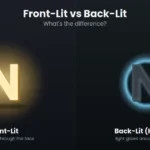
- Front-lit: LEDs sit inside a built-up letter and shine through a translucent face.
- Back-lit or halo-lit: LEDs sit behind the letter, and light glows on the wall around it.
- Edge-lit: light enters the edge of a clear acrylic panel and shows up along cut or engraved areas. This suits panels and logos more than individual letters.
Lighting choices are covered in more depth in a separate guide to illuminated 3D signs (add link when published).
Mounting Methods
- Stand-off mounting: pins or spacers hold the sign a short distance from the wall, creating a floating look and a shadow gap.
- Flush mounting: the sign sits directly on the wall using adhesive or concealed fixings.
- Backing panel: letters are fixed to a panel, which is then mounted. This helps where the wall surface is uneven, delicate or difficult to fix into.
Acrylic Sign Variations at a Glance
| Variation | What it is | Typical look | Common setting |
| Flat-cut letters | Single layer cut from sheet | Clean, simple outline | Offices, reception areas |
| Layered letters | Several layers bonded together | Stepped depth, colour contrast | Retail feature walls, showrooms |
| Built-up letters | Face and returns forming hollow letters | Deep letters, even glow when lit | Shopfronts (sheltered), restaurants |
| Opal or frosted acrylic | Translucent, light-diffusing face | Soft, even glow | Lit signs |
| Mirrored or gloss acrylic | Reflective surface | Bright, high-shine | Boutiques, showrooms |
| Stand-off mounted | Letters held off the wall on pins | Floating look with shadow gap | Reception walls |
| Backing panel | Letters fixed to a panel first | Framed, uniform | Walls where direct fixing is difficult |
Where Do 3D Acrylic Signs Work Best?
Acrylic works best in indoor or sheltered settings where the sign is seen at a moderate distance, though the right choice varies by project.
- Reception and office walls: flat-cut or layered logos with stand-off mounting are common. They read clearly and keep the look uncluttered.
- Retail stores and boutiques: layered or lit acrylic gives shops a way to show colour and depth on feature walls or behind counters.
- Restaurants and cafes: back-lit or opal acrylic can set the mood inside, while built-up letters are sometimes used near entrances.
- Clinics and professional practices: simple, low-gloss finishes suit spaces that need clear, understated signage.
- Showrooms: mirrored, layered or combined-material signs help a brand stand out in a larger interior.
What Are the Benefits of 3D Acrylic Signs?
- Design flexibility. Acrylic can be cut into fonts, logos and custom shapes, and produced in many colours, so the sign can follow the brand closely.
- Depth without heavy weight. Acrylic is much lighter than most metals, which can make large letters easier to handle and mount.
- A range of finishes. Gloss, matte, frosted, mirrored and painted finishes let one material serve very different looks.
- Works with or without lighting. The same design can be unlit, halo-lit or lit through the face, depending on the setting.
- Handles detailed logos when designed for it. Fabricators can cut fine shapes accurately, although very thin strokes and sharp inner corners may need adjustment.
- Practical to fabricate and install. Acrylic can be cut, bonded and finished in a workshop, then mounted with standard fixings.
What Are the Limitations of 3D Acrylic Signs?
Acrylic has real limits, and most of them can be managed with the right specification.
| Limitation | Why it happens | What helps |
| Scratching | Acrylic is softer than metal or glass | Choose a matte finish, clean with soft cloths, avoid high-contact positions |
| Outdoor exposure | Sun, heat and weather affect unsuitable or lower-grade material | Specify an outdoor-suitable grade and discuss exposure with the fabricator |
| Thermal movement | Acrylic expands and contracts with temperature more than many metals | Allow expansion gaps and use suitable fixings |
| Impact and stress | Acrylic can crack if struck or if fixings are over-tightened | Place out of reach, use correct fixings and adequate thickness |
| Dust and static | The surface can attract dust | Clean gently with mild soap and water |
| Fire safety | Acrylic is combustible | Check building and fire-safety requirements, especially for lit signs in enclosed spaces |
| Lighter feel | Acrylic feels less weighty than metal | Consider metal if a heavier, more solid look matters |
Can 3D Acrylic Signs Be Used Outdoors in Hot, Sunny Climates?
Yes, but only with acrylic suited to outdoor use, correct fixing and realistic expectations. Sun, heat and dust are harder on acrylic than indoor conditions, so grade and installation matter more.
Points to think through for hot, sunny regions:
- Sun and colour stability. Outdoor-suitable grades are made to resist UV exposure. Unsuitable grades may discolour or lose gloss over time. Painted or printed surfaces can also fade under strong sun, so ask about UV-resistant finishes.
- Heat and expansion. Acrylic expands as it warms and contracts as it cools. Fixings that hold the sign too tightly can cause stress or cracking, so installers usually allow room for movement. A sign mounted on a hot, dark facade may see higher surface temperatures than the air temperature suggests.
- Dust and sand. Fine dust can build up on the surface. Wiping a dry, dusty sign can scratch it, so rinse or wet the surface before cleaning with a soft cloth.
- Heat from lighting. LEDs generate heat. In enclosed built-up letters, component quality and ventilation matter.
- Direct sun vs shade. A sign shaded by an awning or canopy faces very different conditions from one on an exposed south-facing wall.
Questions worth asking a fabricator: which acrylic grade will be used, whether it is rated for outdoor exposure, how expansion is allowed for, and what warranty applies. Outcomes depend on grade, colour, location and maintenance, so avoid relying on a general promise of lifespan.
How Thick Should a 3D Acrylic Sign Be?
There is no single correct thickness. It depends on the size of the letters, the look you want and how the sign will be mounted.
- Depth of look: thicker acrylic shows a deeper edge, which gives a bolder, more solid appearance.
- Stability: large letters cut from thin sheet can flex or bow, so bigger signs usually need thicker material, layering or a supporting structure.
- Layering: stacking thinner sheets can create depth and colour contrast without relying on one thick sheet.
- Logo detail: very thin strokes and sharp inside corners are more fragile and harder to cut cleanly. Fabricators may suggest slight adjustments to make a logo durable.
- Colour and finish: thickness can change how translucent colours look, especially when lit from behind.
Available thicknesses and finishes vary by fabricator, so it is best to review samples for the specific project.
How Do You Decide If Acrylic Is the Right Material?
Start with where the sign will go and how it will be seen, then check whether acrylic fits.
| Acrylic is usually a good fit when | Consider alternatives when |
| The sign is indoors or sheltered | The sign faces full sun and weather with no suitable outdoor-grade material available. |
| You want flexible colours and logo shapes | You want a heavier, more solid premium look, which metal often gives |
| You want a soft glow through a translucent face | The sign is in a spot where it may be knocked, scratched or handled often |
| The sign is seen at a moderate distance | It will mainly be read from far away, where larger built-up or channel letters are often used |
If more than one row points away from acrylic, compare metal and channel-letter options in the guide to types of 3D sign boards.
How Are 3D Acrylic Signs Made and Installed?
Most projects follow a similar sequence. (A separate article on the full process can be linked here when published.)
- Measure the space. The installer records the wall size, surface type and viewing conditions.
- Prepare the design. The logo or lettering is set out with dimensions, depth, colours and lighting, and approved before production.
- Choose the material. The acrylic type, thickness and finish are selected for the design and environment.
- Cut and finish. Letters are cut by laser or CNC router, and edges are polished or finished.
- Assemble. Layers are bonded, or faces and returns are joined for built-up letters.
- Add lighting if needed. LED modules, wiring and power units are fitted and tested.
- Mount on site. The sign is fixed using stand-offs, adhesive, or a backing panel, and connected to power if lit.
How Do You Clean and Care for Acrylic Signs?
- Use a soft, clean microfibre cloth, not paper towels or rough fabric.
- Clean with mild soap and water, and dry gently.
- Avoid ammonia-based glass cleaners, alcohol and harsh solvents, which can damage the surface.
- Rinse dust off before wiping, especially outdoors.
- Check fixings and lighting from time to time, particularly on larger or outdoor signs.
Frequently Asked Questions About 3D Acrylic Signs
What is the difference between cast and extruded acrylic for signs?
Cast acrylic is poured into molds and cured. Extruded acrylic is pushed through a die. Cast sheet is often preferred for thicker signs and routed or polished work, while extruded sheet usually has more uniform thickness and can cost less. Either can be suitable, depending on the design.
Do acrylic signs yellow or fade over time?
It depends on the grade and exposure. Outdoor-grade acrylic is designed to resist UV damage, while unsuitable grades may discolour. Painted or printed finishes can also fade in strong sun. Ask the fabricator about the specific material and finish.
Can acrylic 3D signs be lit with LEDs?
Yes. Acrylic can be lit through the face, from behind (halo-lit) or from the edge, depending on the construction and the type of acrylic used.
How do you clean an acrylic sign?
Use a soft microfibre cloth with mild soap and water. Avoid ammonia-based cleaners and solvents, and rinse off dust first so it does not scratch the surface.
Can acrylic signs show detailed logos?
Yes, in most cases. Very thin lines and sharp inner corners may be fragile, so fabricators sometimes adjust small details to keep the sign durable.
Is acrylic suitable for a sign in a shopping centre or mall?
Usually, since it is an indoor, sheltered environment. It is still worth checking the landlord’s or centre’s signage rules and any fire-safety requirements before choosing materials and lighting.
Choosing the Right Acrylic Sign for Your Space
3D acrylic sign boards are flexible and well suited to indoor and sheltered settings, but the details matter: the acrylic type, thickness, finish, lighting and mounting all shape the result. Outdoor use depends on grade and conditions, so it deserves a direct conversation with the fabricator.
A useful next step is to note the location, viewing distance, whether the sign should be lit, and the finish you prefer. With that, a fabricator can recommend a suitable specification. If you are planning a dimensional sign, Noor Al Advertising’s 3D sign board services cover design, fabrication and installation.