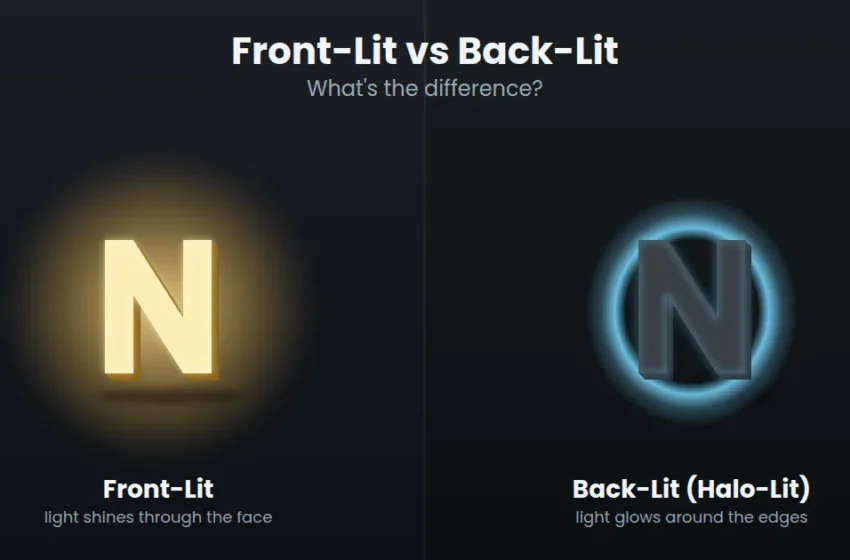
Quick answer: Front-lit signs shine light through the face of the letter, so the letter itself glows and reads clearly at a distance. Back-lit (halo-lit) signs shine light behind the letter onto the wall, so the letter stays solid and a soft glow appears around its edges. Front-lit tends to suit bold, highly visible signage, while back-lit tends to suit a more refined, ambient look.
The difference between front-lit and back-lit 3D signs comes down to where the light shows, not just where the LEDs sit. Both use the same basic components: dimensional letters and LED modules. What changes is the direction the light travels and, with it, how the sign looks by day and by night.
This applies across materials. A front-lit or back-lit sign can be built in acrylic, metal, or as channel letters, so the lighting choice is separate from the choice of material. For a wider look at sign types and materials, see this guide to 3D sign board types.
What Is a Front-Lit 3D Sign?
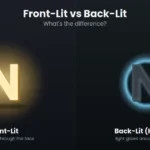
A front-lit sign is one where the light shines through the face of the letter, so the letter itself appears to glow.
The letter is usually a built-up (channel-style) construction with a translucent face, often opal or frosted acrylic. LED modules sit inside the letter, behind that face. When switched on, the light passes through the face material and lights up the whole letter evenly, rather than just its edges.
Front-lit letters typically read as bright and solid at night, since the entire shape lights up. They also work in daylight because the letter’s colour and outline are visible regardless of the lighting. This construction is closely related to acrylic channel-style letters; see 3D acrylic sign boards for more on how translucent acrylic faces are made.
What Is a Back-Lit (Halo-Lit) 3D Sign?
A back-lit sign is one where the light shines out from behind the letter, onto the wall, rather than through the letter’s face.
The letter face is usually solid and opaque, often metal or non-translucent acrylic. LED modules sit behind the letter, facing the wall. The letter itself stays dark or matches its natural material colour, while a ring of light glows around its outline on the mounting surface. This is why the effect is called “halo-lit”: the glow forms a halo around the letter shape.
“Back-lit,” “halo-lit” and, less commonly, “reverse-lit” are generally used to describe the same effect. Different signmakers may favour one term over another, but they point to the same construction.
Front-Lit vs Back-Lit: Key Differences
| Factor | Front-Lit | Back-Lit / Halo-Lit |
| Where the light shows | Through the letter face | Around the letter, on the wall |
| Typical letter appearance | Bright, glowing face | Solid face, glowing outline |
| Daytime visibility | Strong, letter reads clearly without lighting | More subtle, relies on the letter’s own colour and finish |
| Common materials | Translucent acrylic face | Metal or opaque acrylic letters |
| Common feel | Bold, commercial | Refined, ambient |
Three differences matter most when choosing between them:
Legibility at a distance. Because the whole letter lights up, front-lit signs tend to be easier to read from far away or in busy surroundings, which is part of why they’re common on shopfronts and roadside signage.
Day and night impression. A front-lit letter looks similar in daylight and at night, since the shape and colour are visible either way. A back-lit letter can look quite different between day and night: solid and understated in daylight, then defined by a soft glow after dark.
Brand feel. Front-lit signage tends to read as direct and commercial, suited to drawing attention. Back-lit signage tends to read as more restrained, and is often chosen where a subtler, higher-end impression is the goal.
Where Is Each Style Commonly Used?
When Front-Lit Signs Are Typically Chosen
- Shopfronts, where visibility and legibility at a distance matter
- Retail signage on busy streets or in shopping centres
- Roadside or highly visible commercial signage
- Restaurants that want a lit sign to draw attention after dark
When Back-Lit Signs Are Typically Chosen
- Corporate reception walls and lobby signage
- Hotels and hospitality entrances
- Upscale retail, where a subtler look supports the brand
- Feature walls where the sign is part of the interior design, not just a name plate
Can a Sign Combine Front-Lit and Back-Lit Elements?
Yes. Some designs light both the face and the wall behind the letter, giving a layered effect where the letter glows and a halo appears around it. This is more complex to build and typically costs more than a single-method sign, since it needs two lighting layers. It’s worth discussing with a fabricator if you want both effects in one sign, rather than assuming it’s a standard option.
How Do You Choose Between Front-Lit and Back-Lit?
Viewing Distance and Legibility Needs
If the sign needs to be read from a distance or in a busy visual environment, front-lit generally offers stronger legibility. If the sign is seen up close, such as in a reception area, legibility from a distance matters less.
Day and Night Visibility
If the sign needs consistent impact both day and night, front-lit is the more predictable choice. If the daytime look and the nighttime look can differ, back-lit gives a distinct after-dark effect worth considering.
Brand Feel and Setting
A bold, attention-drawing brand often suits front-lit. A brand aiming for a calmer, premium impression often suits back-lit. This is a matter of fit with the setting and the brand, not a rule.
Material and Mounting Compatibility
Front-lit generally needs a translucent face, which points toward acrylic construction. Back-lit generally needs a solid letter and a wall suited to reflecting light evenly, which points toward metal or opaque acrylic, and a mounting surface that isn’t too textured or dark.
| Choose front-lit when… | Choose back-lit when… |
| The sign must be legible from a distance | The sign is viewed at close range |
| You want consistent visibility day and night | A different day and night look is acceptable or desired |
| The setting calls for a bold, commercial look | The setting calls for a subtler, refined look |
| The mounting wall isn’t ideal for reflecting light | The wall is suitable for an even halo effect |
Maintenance and Practical Considerations
Both styles use LED modules that need power and occasional servicing, so access for maintenance is worth planning at the design stage. Back-lit signs depend on the mounting wall to reflect light evenly, so the wall’s colour and texture should be considered during design, not left until installation. Neither style is inherently more power-hungry in a way that would meaningfully affect a typical sign’s running cost, since this depends more on the size and number of LED modules than on the lighting method itself.
Frequently Asked Questions About Front-Lit and Back-Lit Signs
Is halo-lit the same as back-lit?
Generally, yes. “Halo-lit” and “back-lit” both describe light shining from behind the letter onto the wall, creating a glow around its edges. Some signmakers also use “reverse-lit” for the same effect.
Which is more visible during the day, front-lit or back-lit?
Front-lit letters typically read more clearly in daylight, since the whole letter is designed to be visible through its face regardless of lighting. Back-lit letters rely more on their material and finish for daytime visibility.
Can front-lit and back-lit be combined in one sign?
Yes, some designs light both the face and the wall behind it. This is more complex to build than a single-method sign, so it’s worth discussing directly with a fabricator.
Does the choice affect which material I can use?
Yes, to an extent. Front-lit generally needs a translucent face, most often acrylic. Back-lit generally needs a solid, opaque letter, which suits metal or non-translucent acrylic.
Which uses less power, front-lit or back-lit?
Power use depends mainly on the size of the sign and the number of LED modules used, not on whether it’s front-lit or back-lit. There’s no general rule that one method uses meaningfully less power than the other.
Choosing the Right Lighting for Your Sign
Front-lit and back-lit signs create very different impressions from the same basic idea: LED lighting paired with dimensional letters. Front-lit favours visibility and a bold, commercial look. Back-lit favours a subtler, more refined effect. The right choice depends on viewing distance, the setting, and the impression you want the sign to give day and night. If you’re planning an illuminated sign, Noor Al Advertising’s 3D sign board services cover design, lighting and installation.